There is a kind of tiredness that does not come from doing too much, but from never fully arriving in what you are doing.
Days fill quickly. Attention splits just as quickly. And somewhere in that rhythm, life starts to feel slightly out of focus.
Slow living sits against this pace. Not only as an aesthetic or as a system to follow, but as a different way of moving through what is already there.
Beyond the visual language
Slow living is often first encountered through imagery.
Soft interiors, natural materials, light falling across simple surfaces. A sense of space and ease.
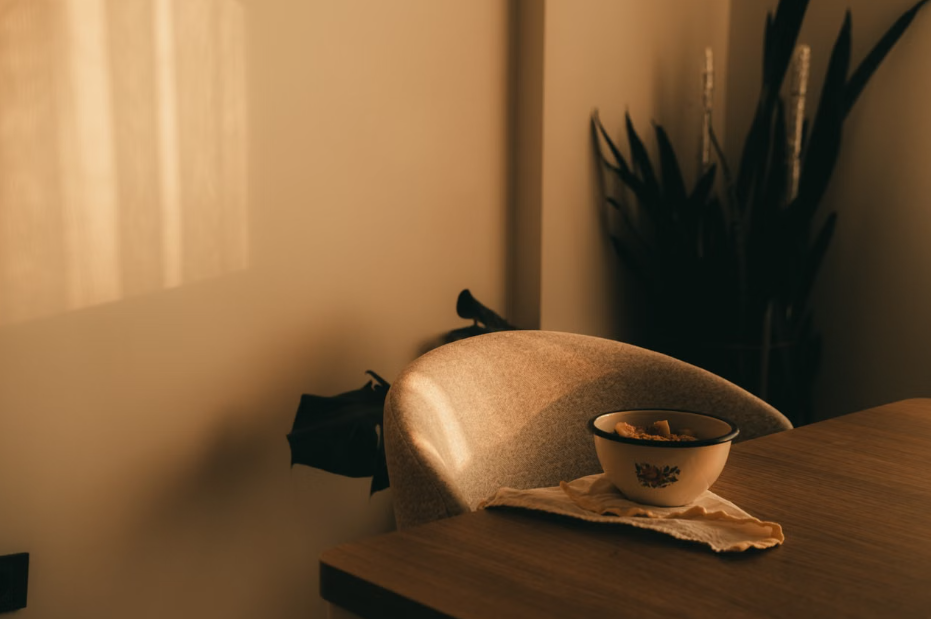
These images are part of its appeal, but they are not the practice itself.
It is possible for life to look calm while still feeling rushed. The visual layer can exist without any real change in rhythm.
Slow living begins where attention changes, not where styling begins.
The question of pace
Not everything asks for the same speed.
Some parts of life work better when they are efficient and direct. Others lose something essential when they are rushed through.
Cooking, eating, thinking, walking, talking. These are small examples, but they shape most days.
Carl Honoré describes this as finding the “right speed” for each situation. Not a slower life, but a more appropriate one.
That distinction matters. It removes the pressure to turn slowness into a performance.
Attention in fragments
Much of modern life is lived in fragments of attention.
A task interrupted by messages. A meal shared with a screen. A moment of rest that is not fully restful.
Nothing about this is unusual anymore, which is why it often goes unnoticed.
Slow living is less about removing technology or activity, and more about returning moments to themselves.
One thing at a time, long enough for it to feel complete.
What changes when attention shifts
When attention becomes less scattered, other things begin to change quietly.
Choices feel less automatic. Consumption becomes more deliberate. There is a greater awareness of what enters daily life and what stays there.
This does not necessarily mean buying less, but choosing with more clarity when a choice is made.
Over time, this often leads toward things that last longer, are used more fully, or simply feel more considered in everyday use.
A quieter relationship with consumption
Sustainability often enters this space naturally, although it is rarely the starting point.
It appears as a shift in instinct rather than a set of rules.
Less interest in quick replacements. More attention to how things are made. More willingness to wait for something that feels right rather than immediate.
Sometimes that looks like handmade objects. Sometimes it looks like practical tools that do their job well and continue to do so over time.
The common thread is care rather than accumulation.
Starting points, not transformations
It begins in smaller adjustments that are easy to overlook:
- finishing one task before starting another
- pausing briefly between actions
- paying attention to how time is actually spent
- choosing with slightly more intention than before
None of this needs to be perfect or consistent.
It is not a system to adopt, but a way of noticing what is already happening.
Closing note
Slow living is not an escape from modern life.
It is a way of being inside it with less fragmentation and more attention.
Nothing external necessarily changes at first. But the experience of ordinary moments can begin to shift—becoming less rushed, and more fully present.